

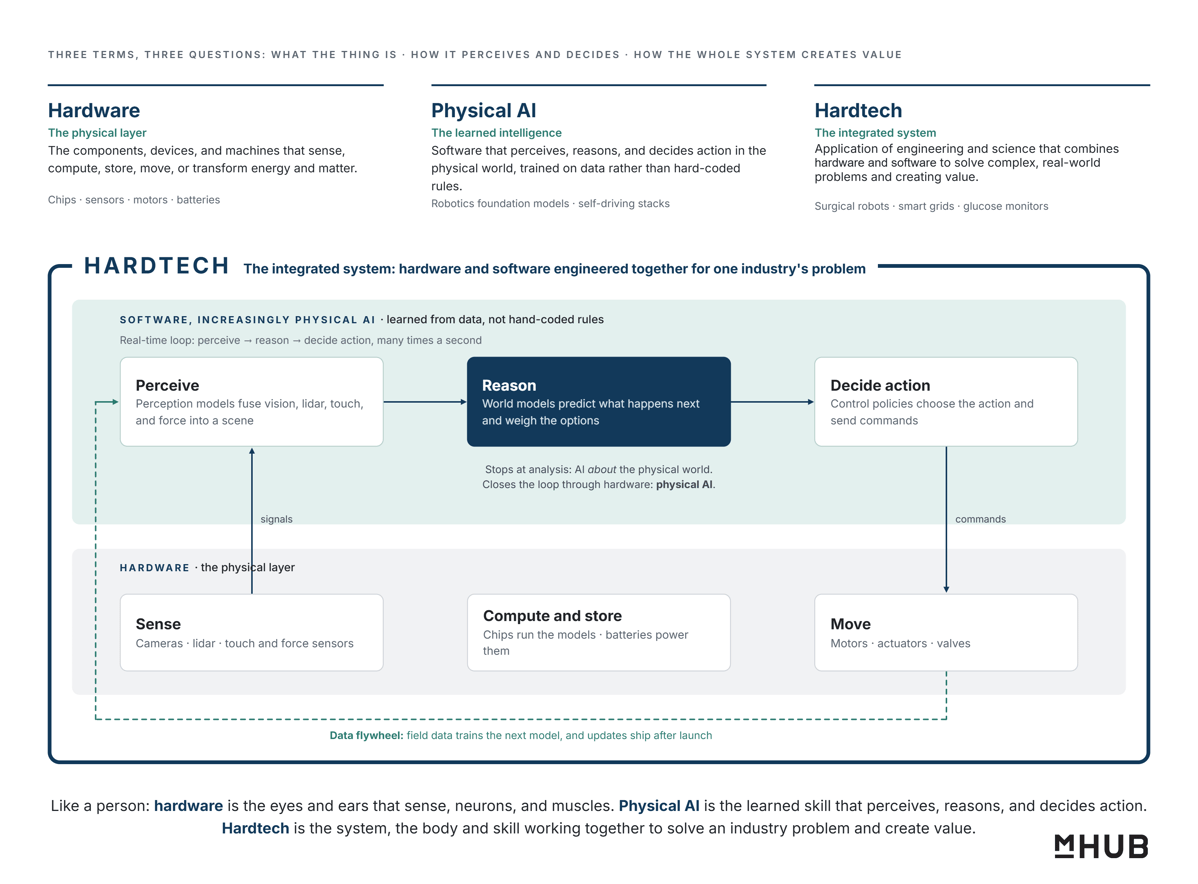
Hardware, physical AI, and hardtech are often used interchangeably even though they mean different things. Each answers a different question. Hardware is about what the thing is. Physical AI is about how the thing perceives and decides. Hardtech is about how the whole system creates value.
Confusing them leads investors, policymakers, and founders to misread where value is being created.
Hardware: the physical layer
Hardware is the physical layer of technology: the components, devices, and machines that sense, compute, store, move, or transform matter and energy. It is defined by physical properties such as size, weight, power, durability, and cost per unit. Semiconductors, motors, batteries, lidar sensors, and an off-the-shelf robot arm are all examples of hardware. Each is essential, and each needs something more before it solves a specific customer's problem.
Physical AI: the learned intelligence
Physical AI is software that lets machines perceive, reason about, and command actions in the physical world, learning how that world behaves from data rather than following rules engineers wrote by hand. This builds on NVIDIA's widely used definition by naming what is new: the behavior is learned.
It works as a loop. Perception models fuse camera, lidar, touch, and force data into an understanding of the scene where world models predict what happens next and learned control policies decide what the machine does. Because this behavior is trained rather than coded, it handles variation no one programmed and can gain new capability through updates long after the hardware ships.
Tesla showed the shift when its FSD v12 update replaced more than 300,000 lines of hand-written C++ with a single neural network trained on video advancing its autonomous driving capabilities.
Broad examples include a robotaxi's driving stack and robotics foundation models such as Google DeepMind's Gemini Robotics. AI that only analyzes physical data, like Augury's machine-health sensors or Sensatek's turbine-monitoring computer vision, is AI about the physical world. Physical AI acts in it.
Hardtech: the integrated system
Hardtech is the application of engineering and science that combines hardware and software to solve a problem for a particular industry. The value is in the integration of the physical system, the software that runs it, and the data it produces, engineered together.
The strongest hardtech becomes a platform that is hard to copy and earns revenue twice, once for the product and again through service or data. Examples in the MedTech space include Dexcom's glucose monitor and app, Intuitive's da Vinci surgical system, and Madison Scientific's SmartShunt. Each pairs a physical device with software designed around clinical problems.
Physical AI is a step change on the software side of hardtech. It's not a separate category but rather an evolution of how the software layer of a physical product interacts with its hardware. It changes hardtech in three ways.
-
Integration still defines the company. A physical AI company that pairs model training with hardware to solve an industry problem is hardtech, commodity parts or not. One that only licenses AI models is AI software serving hardtech.
-
The data flywheel becomes the moat. Deployed machines generate the data that creates the next capability as highlighted by Capgemini.
-
Products keep improving after launch. Learned behavior lets machines gain substantial new capability through updates, and the FDA now allows AI-enabled medical devices to follow a predetermined change control plan for changes after clearance.
In short: hardware is the parts of the body, physical AI is the learned intelligence that runs it, and hardtech is the integrated system that combines them to solve an industry problem.
Where the opportunities are emerging
AI has delivered a step change in computation, and the physical layer is once again the constraint. The opportunities fall into two tiers.
End markets: where physical AI reaches the customer as hardtech.
-
Humanoid robots and general-purpose robots. Agility Robotics' Digit has moved more than 100,000 totes in a GXO warehouse, and Tesla ended Model S and X production in May 2026 to convert the line to Optimus.
-
Autonomous vehicles. Waymo crossed 500,000 paid rides per week in March 2026, about twenty times its early-2024 volume.
-
Robotic medicine. Surgical, imaging, rehabilitation, and lab robots are being pulled forward by clinical labor shortages.
-
Flexible manufacturing. Machines that learn tasks without custom programming make high-mix, low-volume automation viable, from retrofits of existing lines to Hadrian's automated factories.
These markets will be enormous, crowded, and capital-hungry, and most will consolidate around a few platforms.
Picks and shovels: what every end market needs, whichever humanoid or robotaxi company wins.
-
Sensing and touch. Tactile, force, and multimodal sensors feed physical AI the real-world data it lacks.
-
Actuators. Dexterous hands and compact, high-torque motors decide what robots can physically do and at what cost.
-
Energy, storage, and cooling. The International Energy Agency projects data-center electricity demand will more than double to roughly 945 TWh by 2030, driving markets from Submersion cooling to Maxwell Labs' chip-level photonic cooling.
-
AI-accelerated materials. Models are speeding discovery of materials for better batteries, sensors, and chips.
-
Edge computing. Low-power chips that run models on the machine are a prerequisite for safe, real-time autonomy.
Here, differentiated components that command a premium will outperform commodities.
The winners will either own deployed, integrated systems in specific industries or supply the components every such system needs. Both are hardtech, and physical AI makes both more valuable than ever.
mHUB incubates over 300 startups annually who are developing hardtech in categories such as industrial tech, energy, and medical device. The platform includes a Chicago-based incubator and prototyping lab; venture and real estate investment company, mHUB Ventures; and an engineering and product consulting arm. Together, infrastructure, capital, and expertise combine to enable emerging technologies, create new manufacturing businesses, and strengthen U.S. industry.